


 9 min read
 Cozy Hostel in Tula
Living in a hostel can be incredibly comfortable if you know a few simple secrets. Over the years of running the Cozy Hostel in Tula hostel in Tula, we have collected dozens of stories from seasoned travelers -- people who spend weeks and months living in hostels across Russia and the world. We compiled their experience into ten practical life hacks that will transform your hostel stay from "bearable" to genuinely enjoyable.
A hostel is not just a cheap place to sleep. It is a special way of living where you share space with other people, and how well you approach this determines the quality of your rest. Some guests come to us for a single night and leave feeling it was the best travel experience ever. Others check in for a week and feel uncomfortable because they don't know the basic rules of communal living. The difference between these two scenarios is not luck -- it's preparation.
We have divided our life hacks into five categories: sleep, storage, kitchen, socializing, and saving money. Every tip has been tested by dozens of our guests and truly works. Read, remember, apply -- and your next hostel stay will be genuinely comfortable.
 Life Hacks 1-2: Perfect Sleep
Life Hack 1: Earplugs + Sleep Mask = Perfect Sleep
The most common fear of hostel newcomers is "I won't be able to fall asleep because of the noise." And this is a perfectly valid concern: in a room with six to eight people, someone is always tossing and turning, coming in late, or getting up early. But experienced travelers have long solved this problem with two simple accessories: earplugs and a sleep mask.
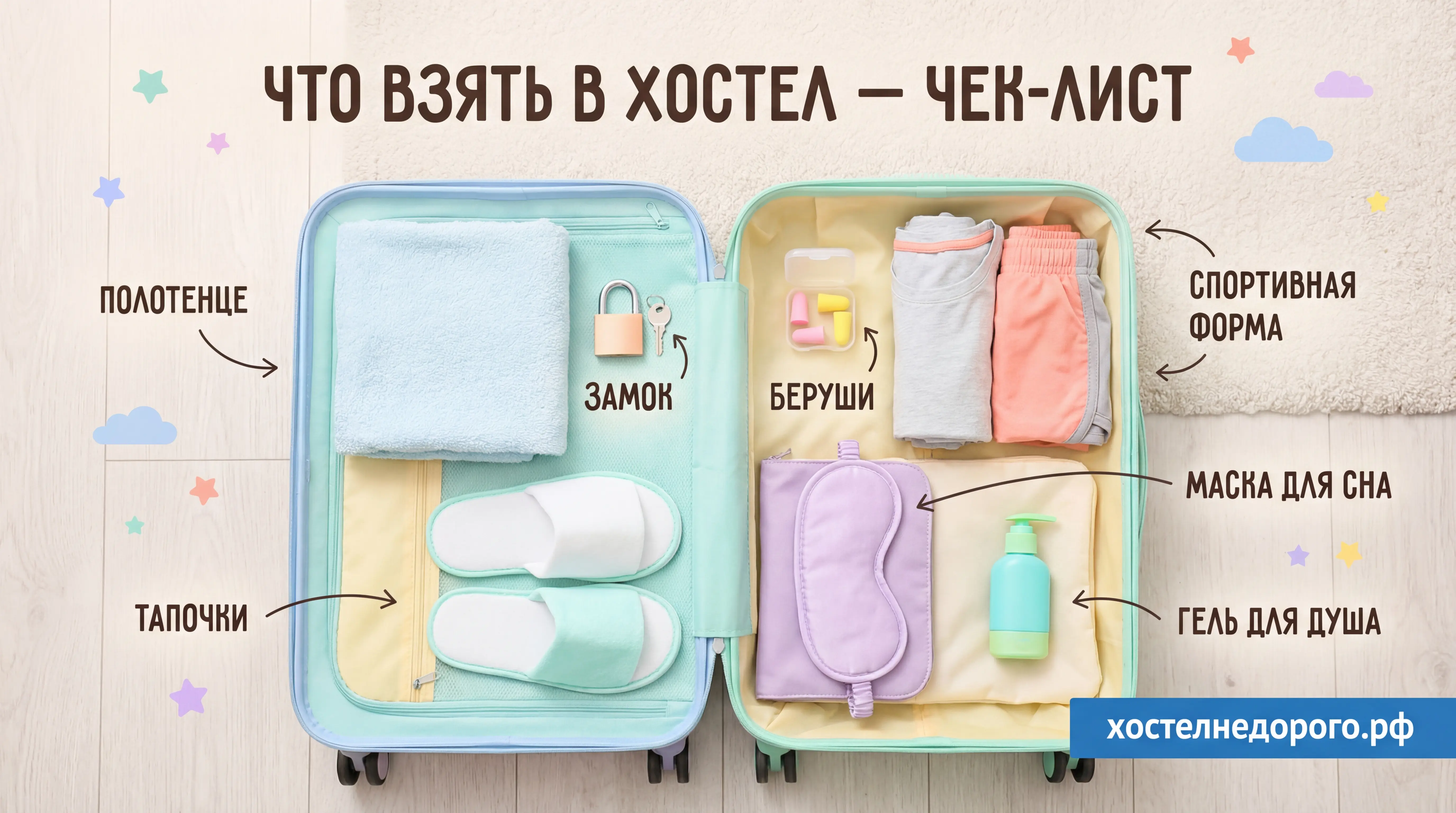
Earplugs are an investment in healthy sleep costing 150-500 rubles (about $2-6). Silicone earplugs that conform to the shape of the ear canal work best. They block up to 33 decibels of noise -- enough to turn a noisy hostel room into a quiet bedroom. Disposable foam earplugs also work, but they need to be replaced every two to three days. Silicone ones last for months.
A sleep mask solves the second problem -- light. Someone turns on their phone flashlight, someone opens the hallway door, a street lamp shines through the window. A mask made of natural silk or dense cotton costs 300-800 rubles (about $4-10) and completely blocks light. Choose models with an adjustable strap and eye cavities -- they don't press on your eyelids, and you literally forget you're wearing one.
Pro tip: keep your earplugs and mask not in your backpack but right on your pillow or in your pajama pocket. When noise wakes you at three in the morning, you can put them on autopilot without fully waking up.
Life Hack 2: Bottom Bunk, Sleep Schedule, and Phone on Silent
If you have a choice when booking, always take the bottom bunk. The upper bunk is hotter (warm air rises), it's harder to climb into after a shower, and every movement from your neighbors below feels like a mini earthquake. The bottom bunk means stability, access to a power outlet, the ability to hang a curtain, and create personal space.
Sleep schedule is another key factor. Try to go to bed and wake up at the same time, even if you're on vacation. Your body adapts to the rhythm within two to three days, and after that, you'll fall asleep instantly regardless of your surroundings. Before bed, avoid bright phone screens for at least 15-20 minutes -- read a book or listen to a podcast with headphones instead.
Phone on silent mode is not just about your comfort -- it's about respecting your roommates. Nothing irritates a sleeping person more than someone else's alarm going off at six in the morning and not being turned off for a full minute. Use vibration or a fitness tracker with a "smart alarm" feature that wakes only you with a gentle wrist vibration.
 Life Hacks 3-4: Storing Belongings
Life Hack 3: Your Own Lock for the Locker and Valuables on You
Most good hostels have individual lockers, but not all provide locks. Buying your own padlock is one of a traveler's best investments. It costs 200-600 rubles (about $3-7), weighs 50-100 grams, and lasts for years. We recommend a combination lock: you'll never lose the key, and you can memorize the code once and for all.
Rule of experienced guests: passport, bank cards, and cash should always be on your person. Even if the locker is securely locked, documents are better carried in a waist pouch or a special hidden wallet that attaches under clothing. This isn't paranoia -- it's a sensible habit practiced by backpackers worldwide. At Cozy Hostel in Tula hostel, we provide spacious lockers that fit a full-size backpack and a laptop, but we always recommend keeping valuable documents on your person.
Before leaving the room -- always check that your locker is locked. It takes two seconds and saves hours of stress. Make it a habit: get up, get dressed, check the lock, walk out.
Life Hack 4: Storage System with Color-Coded Bags
When your backpack is your only "closet" for several days or weeks, keeping it organized is critically important. Experienced travelers use a system of "packing cubes" -- lightweight nylon pouches of different sizes and colors. The principle is simple:
- Red bag -- underwear and socks
- Blue bag -- outerwear (t-shirts, shorts, pants)
- Green bag -- toiletries (toothbrush, shampoo, razor)
- Yellow bag -- electronics (chargers, headphones, power bank)
- Black bag -- dirty clothes (separated from clean ones)
A set of five packing cubes costs 500-1500 rubles (about $6-18) and radically changes hostel life. You no longer rummage through your backpack for ten minutes in a dimly lit room, risking waking your roommates. You simply pull out the right bag, take what you need, and put it back. Thirty seconds instead of ten minutes.

 Life Hacks 5-6: Kitchen and Food
Life Hack 5: Group Dinners -- Savings and Friendship
One of the most powerful hostel life hacks is group dinners. The idea is simple: instead of everyone cooking their own portion of pasta, you team up with two or three roommates and cook one large dish. The savings are immediate: if a solo dinner costs 300-400 rubles ($4-5), a group dinner comes to 150-200 rubles ($2-3) per person. Over a week, that's 700-1400 rubles ($8-17) saved -- comparable to the cost of one or two nights' accommodation.
But it's not just about money. Cooking together is the best way to meet other guests. The warmest conversations happen while chopping vegetables and stirring sauce. We've seen dozens of cases where people who met in the kitchen of Cozy Hostel in Tula hostel later traveled together or became friends for years.
Budget ideas for the hostel kitchen:
- Pasta with tomato sauce -- 80 rubles (~$1) per serving, ready in 15 minutes
- Rice with vegetables -- 60 rubles (~$0.70), add chicken for another 100 rubles
- Cheese and herb omelet -- 70 rubles (~$0.85), the perfect breakfast
- Buckwheat with stewed meat -- 120 rubles (~$1.50), hearty and traditionally Russian
- Blini (Russian pancakes) -- 50 rubles (~$0.60) per serving, loved by everyone including foreign guests
Life Hack 6: Label Your Food and Clean Up Immediately
The shared kitchen is a zone of potential conflicts. Someone ate someone else's yogurt, someone left a dirty pan on the stove, someone forgot their food in the fridge for a week. All these problems are solved by two simple rules.
Rule one: label everything. Make it a habit to put a sticker or a piece of tape with your name and date on your food in the fridge. It takes five seconds but eliminates 90% of kitchen conflicts. Nobody eats yogurt with someone else's name on it -- it's a psychological barrier that works flawlessly.
Rule two: wash your dishes immediately after eating. Not "later," not "in an hour," not "in the morning." Immediately. It takes three minutes, but if every guest puts off washing "until later," by evening the sink turns into a mountain of dirty dishes. At Cozy Hostel in Tula hostel, we provide everything needed for washing: sponges, dish soap, and hand towels. Your job is simply to use them right after your meal. This is not just a hygiene issue -- it's a sign of respect for other guests who also want to cook in a clean kitchen.
 Life Hacks 7-8: Socializing and Atmosphere
Life Hack 7: Introduce Yourself on the Very First Day
Many guests check into a hostel and don't talk to anyone for the first two or three days, too shy to make the first move. Then they leave regretting they didn't meet the interesting people who lived in the room next door. Don't make this mistake.
The golden rule: on your very first day, once you've checked in and unpacked, go to the common area -- kitchen, lounge, or lobby -- and simply say: "Hi, I'm [name], I'm from [city]. Anyone want to go for a walk together?" It sounds simple, but it works 99% of the time. People in hostels are generally open to socializing -- that's exactly why they chose a hostel over a hotel.
If you're an introvert and find it hard to start a conversation from scratch, use "bridges": board games (many hostels provide them for free), a book on the common shelf, a kettle in the kitchen. The phrase "Would you like some tea?" is a universal icebreaker that works across all cultures.
What this gives you: making connections in a hostel is one of the main values of this travel format. We know dozens of stories where guests of Cozy Hostel in Tula hostel explored the Tula Kremlin together, shared route recommendations, and even planned joint trips to other cities. One of our guests from Novosibirsk met a couple from Germany, and six months later they reunited in Berlin.
Life Hack 8: Respect Quiet Hours and Use Headphones
The flip side of socializing is knowing when to be quiet. Every hostel has quiet hours, usually from 11 PM to 7 AM or from 10 PM to 8 AM. Respecting this rule is the foundation of hostel etiquette. Even if you think you're whispering, in the silence of a nighttime room every sound is ten times louder.
Headphones are an essential hostel accessory, right up there with earplugs. Want to watch a video, listen to music, or make a video call? Please do -- but only with headphones. This rule applies not just at night: during the day, someone may be resting after a night shift, studying for an exam, or simply wanting peace and quiet.
A few etiquette rules that everyone will appreciate:
- Don't turn on the overhead light after 11 PM -- use your phone flashlight pointed downward
- Rustling plastic bags are enemy number one in a dark room. Transfer everything you need for the night in advance
- If you wake up before everyone else, gather your clothes and shoes the night before and get dressed in the hallway
- Alarm -- vibration only, or use a smartwatch
These small things may seem insignificant, but they're exactly what distinguishes a "good roommate" from "that guy everyone hated." Be the first type, and others will respond in kind.

 Life Hacks 9-10: Saving Money
Life Hack 9: Discounts for Long-Term Stays
Not everyone knows this life hack, but it can save you thousands of rubles. Most hostels offer significant discounts for extended stays. If the standard nightly rate is 500 rubles (~$6), booking for a week might bring it down to 400 rubles (~$5), and for a month -- to 350 rubles (~$4). Let's do the math: 500 rubles per night times 30 days is 15,000 rubles ($180). And 350 rubles times 30 days is 10,500 rubles ($126). That's a saving of 4,500 rubles ($54) -- almost a third of the cost!
But you need to ask for the discount. Many hostels don't advertise long-term rates on their website, but gladly offer them when contacted directly. Write to the hostel before booking: "I'm planning to stay for 2 weeks / a month. Do you offer a discount for long-term stays?" Nine times out of ten, the answer will be "yes."
At Cozy Hostel in Tula hostel, we offer discounts of 15% and more for stays of a week or longer, and up to 30% for stays of a month or more. Many of our guests -- shift workers, interns, and digital nomads -- stay with us for weeks, saving significant amounts compared to renting apartments by the night.
Life Hack 10: Doing Laundry at the Hostel Instead of Laundromats
Laundry is a hidden travel expense. A commercial laundromat in town charges 400-600 rubles ($5-7) per load, and if you add drying -- 700-800 rubles ($8-10) total. Over a month of travel with weekly washes, that's 2,000-3,200 rubles ($24-38). A washing machine at a hostel typically costs 100-200 rubles ($1-2) per wash, and at some hostels -- it's free.
A life hack within a life hack: use a small tube of universal laundry detergent (sold at travel shops for 100-150 rubles / $1-2). Small items -- socks, underwear, a t-shirt -- can be quickly hand-washed in the sink and hung to dry overnight. It's free and takes five minutes. By morning, they'll be dry, especially if you pre-wring them in a towel.
Other ways to save at a hostel:
- Free breakfasts. Many hostels include a basic breakfast in the price -- don't skip it. That's 200-300 rubles ($2-4) saved every morning.
- Tea and coffee. Virtually all hostels provide a kettle and basic tea/coffee for free. Don't buy a 250-ruble ($3) latte at a cafe when you can drink tea in the kitchen.
- Transportation. A centrally located hostel saves on taxis. If you're a 10-minute walk from all attractions, you won't spend a single ruble on transport for the whole week.
- Local tips. Ask the staff where to eat cheaply, which museums are free on certain days, and where to find the best sunset view. Local knowledge is priceless and free.
Summary Table of Life Hacks
| # | Life Hack | Category | Benefit |
|---|---|---|---|
| 1 | Earplugs + sleep mask | Sleep | Health |
| 2 | Bottom bunk + schedule | Sleep | Health |
| 3 | Own padlock for locker | Safety | 300₽ saved |
| 4 | Packing cube system | Organization | Time |
| 5 | Group dinners | Kitchen | 500₽/day |
| 6 | Label your food | Kitchen | Peace of mind |
| 7 | Introduce yourself on day one | Social | Experiences |
| 8 | Respect quiet hours | Social | Friendships |
| 9 | Long-stay discount | Savings | 20-30% |
| 10 | Laundry at the hostel | Savings | 200₽ instead of 500₽ |
Try our life hacks at Cozy Hostel in Tula hostel!
Central Tula, from 400₽/night (~$5), shared kitchen, lockers, Wi-Fi, long-stay discounts. Everything for comfortable living is ready. All you need to do is check in!
 Frequently Asked Questions
The first couple of days may feel unfamiliar, but adaptation happens quickly. The key is to immediately introduce yourself to your roommates and learn the layout of the kitchen, showers, and common areas. Bring earplugs and a sleep mask -- this will relieve the main stress of shared living. By the second or third day, you'll feel right at home, especially if you actively participate in hostel life: group dinners, board games, and walks with other guests. Remember that most people in a hostel are travelers just like you, open to socializing and making new friends.
Yes, many modern hostels are excellent for remote work. At Cozy Hostel in Tula hostel, there is stable Wi-Fi, a common area with comfortable tables and power outlets, and quiet hours that allow you to focus. For video calls, it's best to use the common lounge during the daytime when most guests are out exploring. Many digital nomads live in hostels for weeks and months, combining work and travel. The main tip -- always use headphones and make sure your laptop is fully charged or that there's a free outlet nearby.
Snoring is one of the most common problems in hostels, and the best solution is quality silicone or foam earplugs with an NRR 33 dB noise reduction level. They cost 200-500 rubles and solve the problem in 90% of cases. A white noise app on your phone and sleep headphones also help. If the snoring is extremely loud, don't hesitate to ask the administrator to move you to another room -- this is a perfectly normal practice. You can also try gently asking the snoring neighbor to roll onto their side -- snoring often stops with a change of position.
 Read Also